


When you purchase fasteners in large quantities, the nut itself may seem like a small part of the total cost. But for distributors, wholesalers, hardware importers and manufacturers, nut purchasing can represent a significant and recurring expense.
A small difference in unit price can become a substantial saving when you purchase tens or hundreds of thousands of pieces.
That is why Meigesi Fastener focuses not only on supplying standard nuts, but also on providing competitive pricing, consistent quality and flexible supply for frequently purchased nut products.
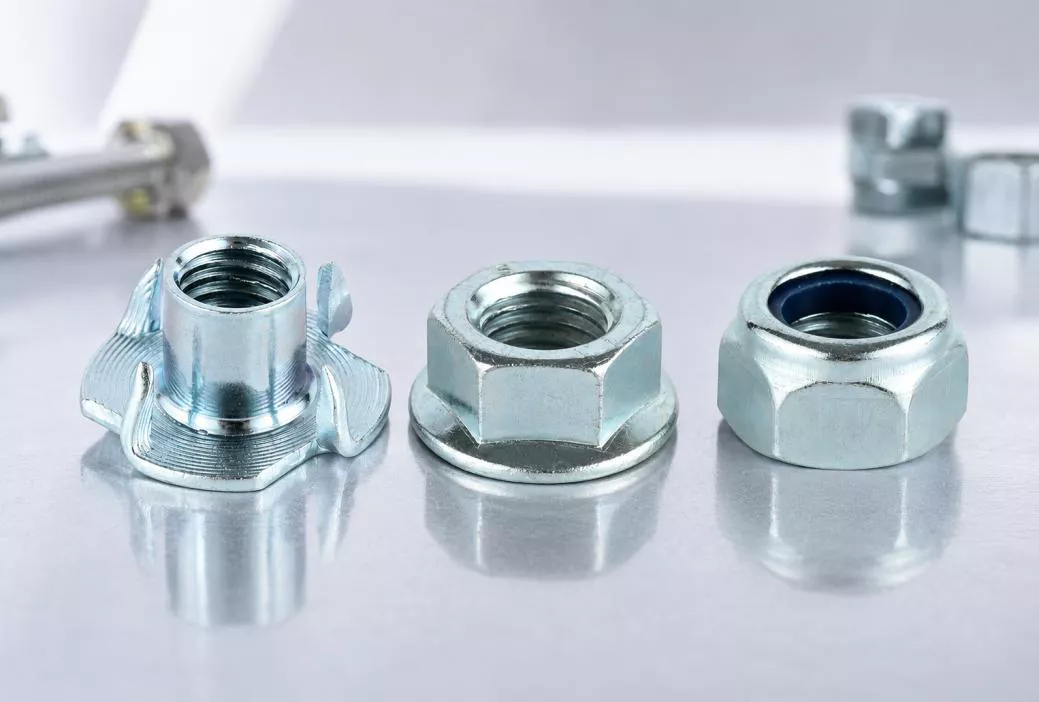
Among our nut range, three products are particularly suitable for regular industrial and hardware procurement:
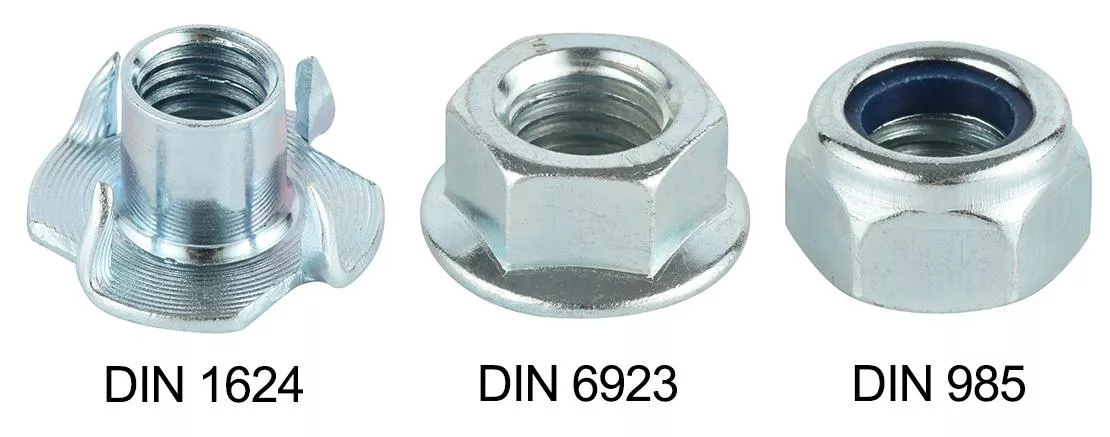
Although all three are nuts, they serve very different purposes. Understanding these differences can help buyers select the right product and, more importantly, find a supplier that can provide the right specifications at a competitive cost.
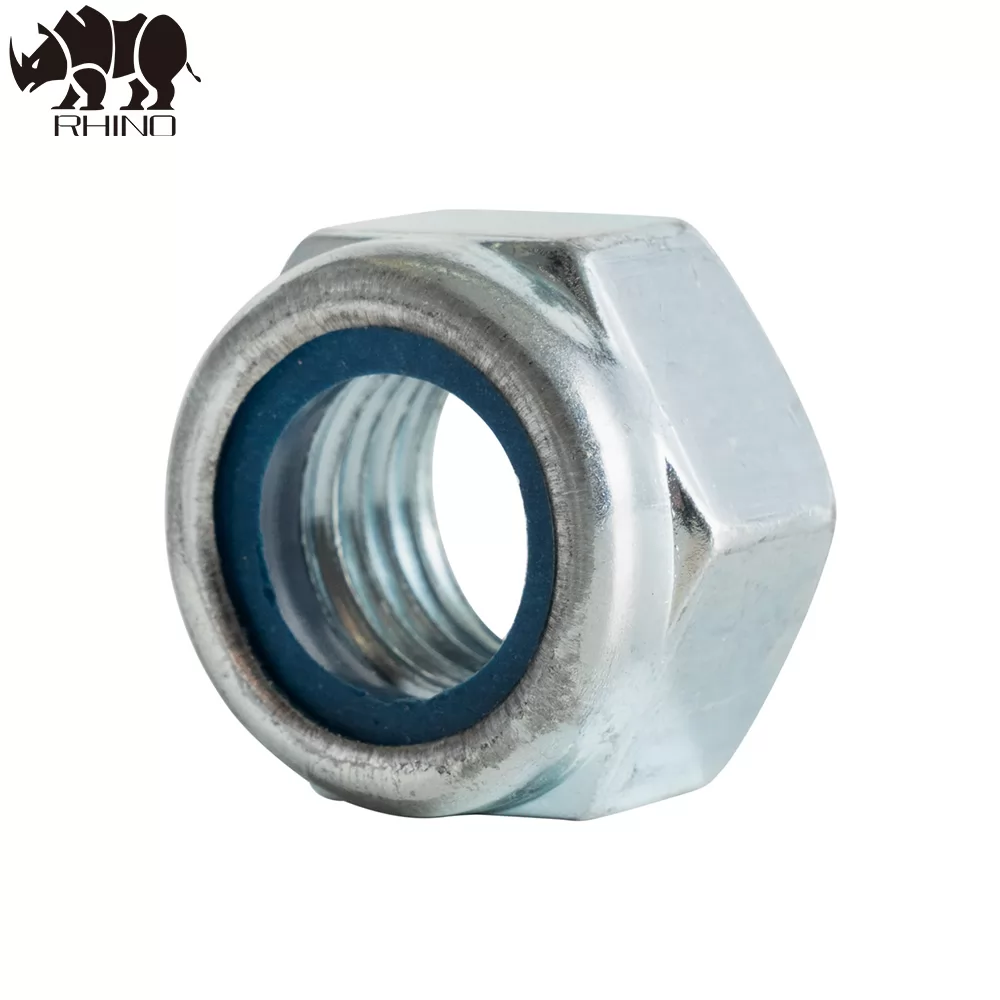
Steel Lock Hexagonal Nut With Nylon Insert DIN985 is a self-locking hexagonal nut with a nylon insert inside. Made of steel, it has high strength and can withstand large tension and compression. The nylon insert provides additional locking force, making it stable in high vibration environments. Meigesi Fastener can provide nuts of different specifications and materials, such as 304 stainless steel, carbon steel, etc.
DIN 985 is a prevailing torque type hexagon thin nut with a non-metallic insert, commonly known as a nylon insert lock nut or Nyloc nut. The nylon insert creates additional resistance against rotation after the nut is installed.
Unlike a standard hex nut, DIN 985 is designed for applications where vibration or movement may cause a conventional nut to loosen.
The basic structure consists of:
The nylon insert interferes with the mating thread and generates prevailing torque, helping the assembly maintain its position during service.
DIN 985 nuts are commonly considered when additional resistance to loosening is required.
Typical applications include:
For buyers supplying different industries, DIN 985 is therefore a practical stocking item.
The standard is also widely recognized in the European fastener market, making it particularly relevant for distributors serving customers who specify DIN standards.
The main advantage is simple:
It combines a familiar hex nut configuration with a built-in locking function.
This eliminates the need for a separate locking washer in some applications, depending on the assembly design and engineering requirements.
Meigesi can supply DIN 985 nuts in different materials and specifications. Our existing product information includes carbon steel and stainless steel options, including 304 stainless steel.
For buyers, the important point is not simply whether a supplier can make DIN 985.
The real question is:
Can the supplier offer the specification you need at a competitive price and maintain consistent quality for repeat orders?
That is where Meigesi aims to provide additional value.
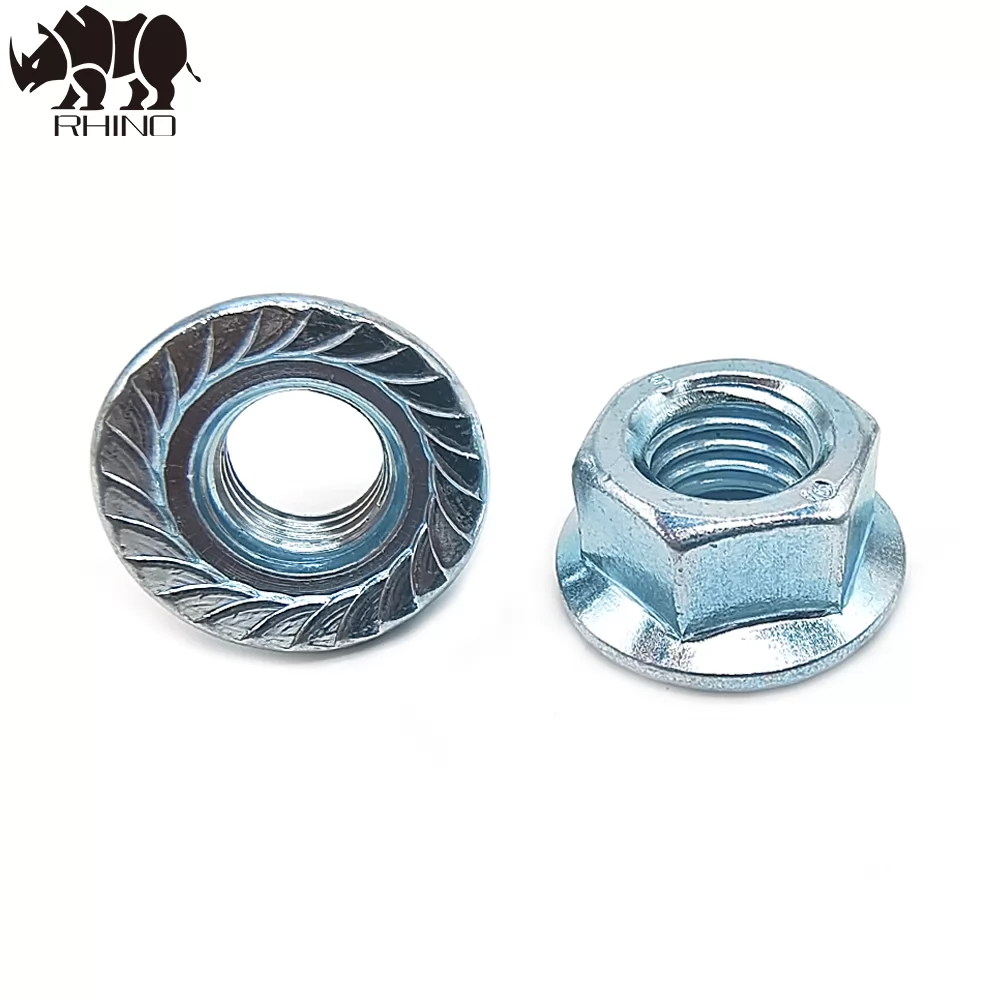
The DIN 6923 Hexagonal Flange Nut combines a hexagonal head with a flat flange featuring serrations. These high-strength nuts are commonly used in machine and automobile construction, ensuring reliable fastening of units and structural elements. The serrated flange displaces material on the mating surface during installation, creating a connection that resists loosening.
DIN 6923 is the standard for Hexagon Flange Nuts. Compared with a conventional hex nut, a flange nut has an integrated flange beneath the hexagonal body.
The flange works similarly to a built-in washer.
It increases the bearing area between the nut and the connected component, helping distribute the clamping load over a larger surface.
This makes DIN 6923 especially useful where a conventional hex nut and separate washer would otherwise be used.
Commonly requested sizes listed for DIN 6923 include:
M5, M6, M8, M10, M12, M14, M16 and M20.
Fine-thread options may also be specified depending on the size and application.
For many assemblies, the difference appears small.
But for high-volume production, eliminating an additional washer can simplify assembly and reduce the number of components that need to be purchased, stocked and installed.
A flange nut provides:
Nut + integrated bearing flange
instead of:
Nut + separate washer
This can be useful in applications where assembly efficiency and component consolidation are important.
DIN 6923 nuts are widely used in:
For fastener distributors, DIN 6923 is also a practical product because it covers a broad range of general industrial applications.
This is an important point for buyers.
A standard DIN 6923 flange nut should not automatically be described as a serrated flange lock nut.
There are different flange nut designs, including versions with serrations or locking features, and they should be specified separately according to the required standard and product design.
Therefore, when requesting a quotation, it is better to clearly specify:
DIN 6923 + size + material + surface treatment + whether serrations are required.
This helps avoid misunderstandings between standard flange nuts and serrated flange lock nuts.
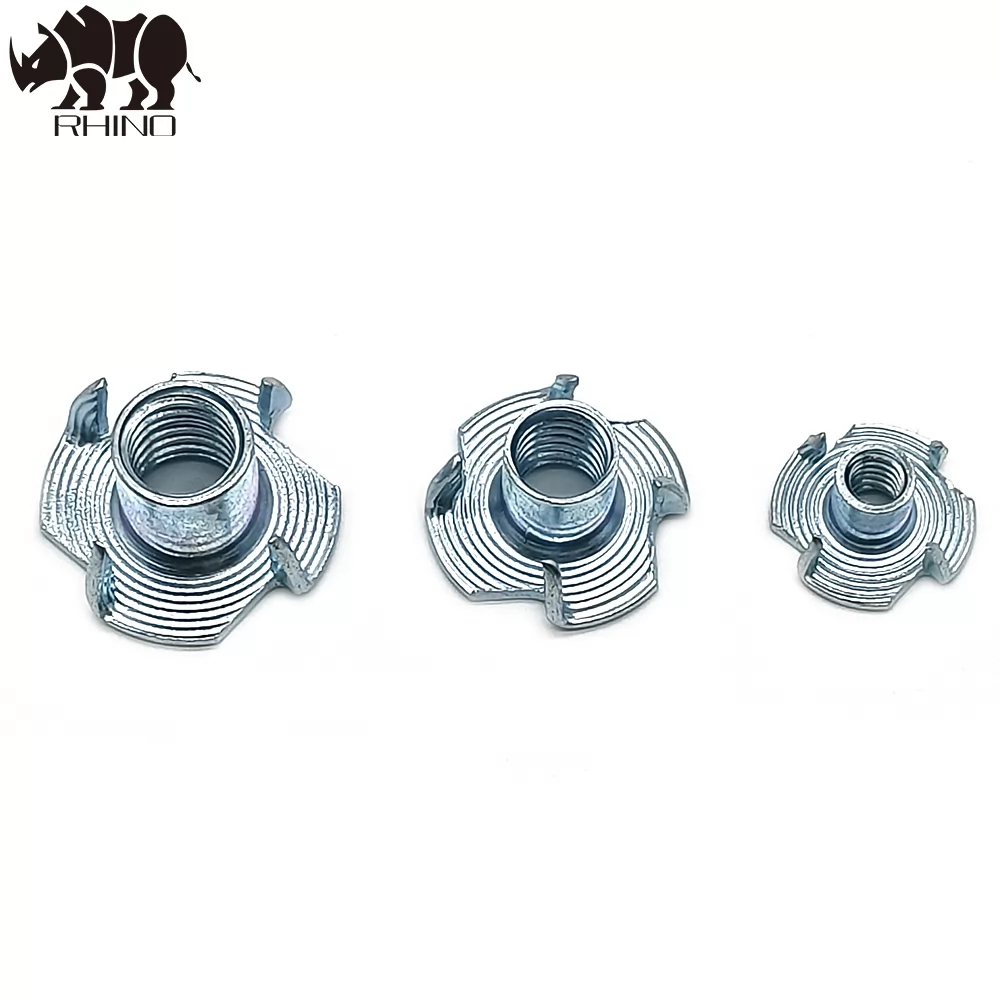
DIN1624 Four Claws Tee Nuts are versatile fasteners used in furniture assembly. Also known as 4-prong tee nuts, they can be made by cold forging or stamping. These nuts feature four claws that securely grip wood or other materials. Available in sizes from M4 to M12, they come in carbon steel or stainless steel (A2-70, A4-80). The surface treatment options include zinc plating (in blue, white, or yellow).
DIN 1624 is commonly associated with four-prong tee nuts, also called four-claw tee nuts or T-nuts.
Unlike DIN 985 and DIN 6923, this nut is not primarily designed for conventional metal-to-metal bolted assemblies.
Its main advantage is its ability to create a threaded fastening point in materials such as wood and panels.
The four prongs or claws are pressed into the substrate. Once installed, they help prevent the nut from rotating when the mating screw or bolt is tightened.
This makes DIN 1624 particularly useful for furniture and woodworking applications.
The YJT database lists the metric version as YJT 3023 (DIN 1624), with common metric sizes including M4, M5, M6, M8 and M10.
Meigesi also supplies DIN 1624 four-claw tee nuts in carbon steel and stainless steel options, with zinc-plated surface treatments available in different finishes.
Typical applications include:
For furniture hardware distributors, DIN 1624 can be a particularly useful stocking product because it serves a completely different application from conventional hex nuts.
The three products can be easily confused if you only look at the word “nut.”
Their functions are actually very different.
| Product | Main Feature | Typical Application |
|---|---|---|
| DIN 985 | Nylon insert locking function | Machinery, automotive, equipment |
| DIN 6923 | Integrated flange | General industrial and mechanical assembly |
| DIN 1624 | Four-prong fixing design | Furniture, wood and panel assembly |
A simple way to remember them is:
DIN 985 → Locking
DIN 6923 → Load distribution
DIN 1624 → Fixing into wood/panels
Choosing the correct type is important, but for professional buyers, product selection is only half of the job.
The other half is finding a supplier who can provide the required products at the right price.

Nuts are typical high-volume fasteners.
A customer may not purchase 10000 pieces.
They may purchase:
At these quantities, even a small difference in unit price can have a meaningful impact on the final purchasing cost.
For example, if your annual purchase is 500,000 pieces, a difference of only USD 0.005 per piece represents:
500,000 × 0.005 = USD 2,500
This is why competitive pricing matters.
However, the lowest price is not necessarily the best purchasing decision.
A low quotation is only useful if the supplier can also maintain:
Otherwise, a low initial price can easily become an expensive procurement problem.
Meigesi’s advantage is not simply that we offer nuts.
We understand that nuts are often purchased as repeat-volume products.
For distributors and importers, purchasing decisions are usually based on a combination of:
Price + Quality + Availability + Consistency + Service
Meigesi’s existing product range includes a variety of standard nuts, and the company supports manufacturing according to DIN, ISO, ANSI, BS, JIS and customer requirements.
Our strengths include:
For high-volume standard nuts, price competitiveness is one of the areas where Meigesi can offer value to buyers.
If you already have a regular purchasing quantity, send us your current specification and target quantity.
We can quote according to your actual requirement rather than giving you a generic price.
DIN 985, DIN 6923 and DIN 1624 serve different applications.
Being able to source multiple products from the same supplier can simplify procurement and shipment management.
For professional buyers, the DIN number is more than a product name.
It defines important dimensional and technical requirements.
Our products can be manufactured according to applicable DIN and other international standards, as well as customer-specific requirements.
Depending on the product and application, different material and surface treatment requirements can be considered.
For example:
Carbon steel
Suitable for many general industrial applications and commonly selected when cost efficiency is important.
Stainless steel
Suitable when improved corrosion resistance is required. Meigesi offers stainless options for selected nut products, including 304 stainless steel and A2-70 options.
Zinc plating
A practical choice for carbon steel nuts where improved surface corrosion resistance and appearance are required.
The exact material, coating and performance requirements should always be confirmed when requesting a quotation.
If you regularly purchase DIN 985, DIN 6923 or DIN 1624 nuts, your current supplier may not necessarily offer the most competitive price.
The easiest way to find out is to compare.
Send Meigesi your:
Product specification + quantity + material + surface treatment + packaging requirement
and let us prepare a quotation for you.
You do not need to change suppliers immediately.
Just compare the numbers first.
If the price is competitive and the quality meets your requirements, Meigesi can become another reliable source for your nut purchasing.
Whether you are a fastener distributor, hardware wholesaler, furniture hardware supplier, importer or industrial buyer, we welcome your inquiry.









.png)
