


![[请替换为实际图片路径:Cold Heading Banner]](https://www.meigesi.com/uploads/202608/Cold Heading Technology_1786928701_WNo_1672d941.webp)
Why Is Cold Heading Technology the Core of Modern Fastener Manufacturing?
In our daily lives and industrial production, fasteners are almost everywhere. From automobile engines and bridge structures to wind power equipment, steel structures, and mechanical systems, countless connections rely on fasteners such as bolts, screws, and studs to achieve secure and reliable assembly.
Although fasteners appear to have relatively simple structures, the manufacturing process behind a high-quality bolt actually involves multiple complex stages, including material selection, heat treatment, surface treatment, tooling design, and precision forming.
Among these processes, cold heading technology is one of the most fundamental and critical manufacturing methods in the fastener industry.
Today, a wide range of standard fasteners, including hex bolts, socket head cap screws, self-drilling screws, rivets, and studs, are manufactured using cold heading processes.
Compared with traditional machining methods, cold heading offers significant advantages, including greatly improved production efficiency, enhanced mechanical properties, and higher material utilization. Therefore, the level of cold heading technology has become an important indicator of a fastener manufacturer's overall manufacturing capability and technical strength.
So, how does cold heading transform ordinary metal wire into complex and high-performance fasteners? What key technologies are involved behind this advanced forming process?
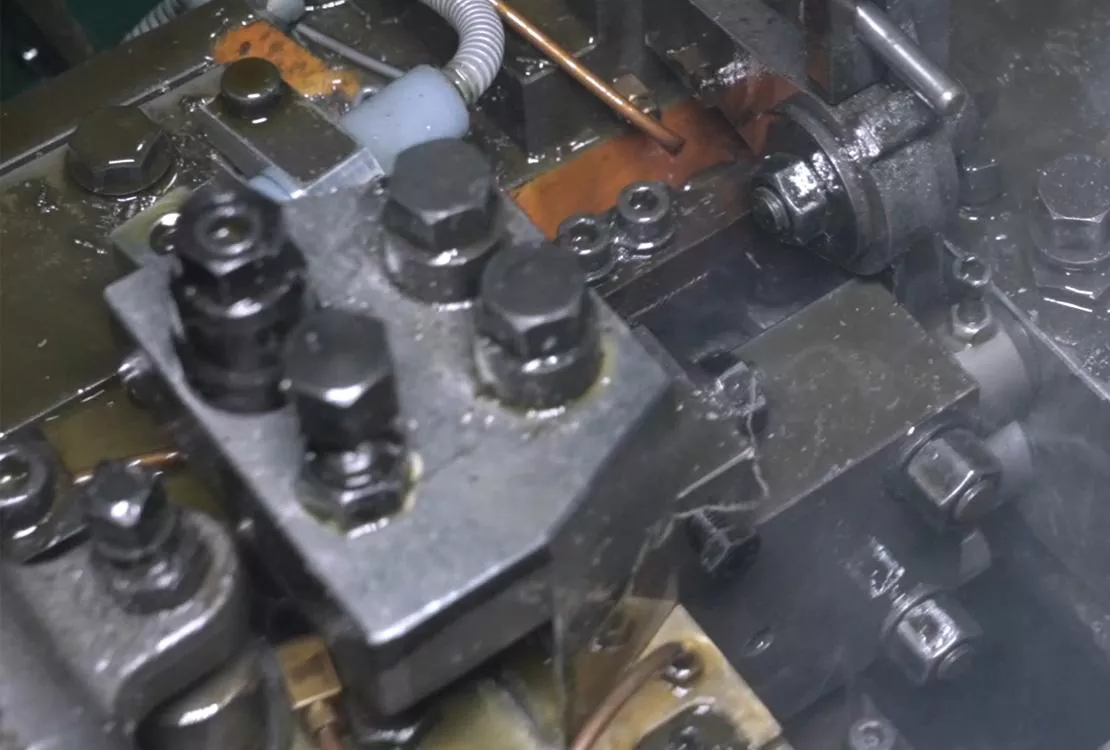
Cold heading, also known as cold forging, is a manufacturing process that uses the plastic deformation capability of metals to form components at room temperature. Simply put, cold heading changes the shape of metal through applied pressure rather than removing material through cutting operations.
During the production process, manufacturers first select qualified wire rod materials that meet specific requirements. The wire rods then undergo a series of pre-treatment processes, including spheroidizing annealing, acid pickling, phosphating, and wire drawing, to improve their surface condition and ensure excellent formability. After these treatments, the processed metal wire is fed into a cold heading machine.
The cold heading machine performs a series of automated operations, including automatic feeding, precise cutting, blank positioning, and punch forming. Under the pressure applied by the punch, the metal material flows into the die cavity and takes the designed shape to form the fastener head or other special structures.
Throughout this process, the metal undergoes controlled plastic flow under extremely high pressure. Instead of being removed, the material is redistributed and rearranged according to the shape and dimensions of the forming dies.
For example, when manufacturing a hex bolt, the original material may simply be a round steel wire. After the cold heading process, the material flows into the hexagonal cavity of the die, forming a complete hexagonal bolt head. This process is similar to pressing modeling clay by hand—the material does not disappear but changes its shape according to external pressure and spatial limitations. Cold heading technology applies the same principle in a highly controlled industrial environment with much higher pressure and precision, enabling the efficient production of complex and high-performance fasteners.
Many people consider cold heading to be simply a type of "stamping process," but in reality, it involves complex metal flow principles and precise control of material deformation behavior.
When metal materials are subjected to external forces, they generally experience two stages of deformation:
The first stage is elastic deformation. When the external force is removed, the material returns to its original shape.
The second stage occurs when the applied pressure exceeds the material's yield strength, causing plastic deformation. At this stage, even after the external force is removed, the material will no longer return to its original shape but will retain its newly formed structure.
Cold heading technology utilizes precisely this second stage of metal behavior. However, metal does not deform randomly during the forming process. To achieve stable production and high-quality fasteners, engineers must fully understand and control the laws of metal flow.
Among them, the two fundamental principles of cold heading are the most important factors that determine the success of the forming process.
The Law of Minimum Resistance in Plastic Deformation is one of the fundamental theories behind cold heading die design. Its core principle is that during plastic deformation, metal will preferentially flow in the direction where resistance is lower.
During the cold heading process, the flow behavior of metal is influenced by multiple factors, including:
Together, these factors determine the final flow direction of the metal during forming.
For example, when manufacturing a bolt head, the punch applies pressure from the top downward. Without any die restrictions, the metal would mainly move along the axial direction. However, because the die limits the available axial space, the material encounters resistance and begins to flow toward directions with lower resistance. As a result, the metal expands outward and gradually fills the hexagonal cavity, forming the complete bolt head.
This explains why the same piece of raw material can be transformed into completely different types of fasteners simply by changing the die structure.
Another essential principle in cold heading design is the Law of Volume Conservation, which states that the overall volume of metal remains basically unchanged during plastic deformation.
In other words, the amount of material required for the finished part must be accurately calculated and prepared in advance through the correct blank volume.
For example, a bolt consists of a head section and a threaded shank. Before production, engineers need to calculate:
If the calculation is inaccurate, insufficient material may result in incomplete head filling, undersized hexagonal dimensions, and reduced product strength. On the other hand, excessive material can lead to increased forming pressure, reduced die life, and higher production costs.
Therefore, cold heading manufacturing does not rely solely on the force of the machine. Instead, it depends on precise material volume calculation, accurate die design, and controlled metal flow to achieve consistent and high-quality fastener production.
Cold heading forming design is mainly divided into two types: open die heading and closed die heading.
Open die heading is one of the more traditional forming methods. In this process, the material has relatively more free space to deform during forming. Due to fewer restrictions from the tooling, the metal can flow outward more easily and rapidly. Compared with closed die heading, open dies are generally simpler in structure, have lower manufacturing costs, and are suitable for producing fasteners with relatively simple geometries. However, because the material flow is less restricted, open die heading has limited capability when producing components with complex structures and precise shapes.
Unlike open die heading, closed die heading forms the material inside a relatively enclosed die cavity. During the forming process, the metal has very limited space for free movement and undergoes controlled plastic deformation within the precisely designed tooling. This process is similar to forcing a piece of metal into a specially engineered cavity, allowing it to gradually take the desired shape through controlled material flow.
Because the material flow is strictly guided by the die cavity, closed die heading provides better dimensional consistency and product stability. For example, when manufacturing a bolt head, traditional machining requires a larger diameter material first and then removes the excess material through cutting operations. In contrast, cold heading achieves the desired shape by redistributing the existing material, generating very little metal waste. For high-volume production, this significantly reduces material consumption and manufacturing costs.
However, closed die heading requires higher levels of technical expertise and process control. Since the material flow space is limited, issues such as inaccurate blank volume calculations, improper die clearance design, or uneven deformation distribution may result in excessive forming pressure, product cracking, premature die failure, or dimensional deviations.
Therefore, closed die heading is not only a test of equipment capability but also a reflection of a manufacturer's expertise in process design, tooling technology, and production experience.
During the cold heading production process, not all fasteners are formed using the same deformation method. Depending on the product structure and the characteristics of material flow, engineers need to select the most suitable forming approach to achieve stable and accurate results.
The common cold heading deformation methods mainly include:
The term "small material with large deformation" refers to using relatively small-diameter wire material and applying significant plastic deformation to form a product with a larger structural size.
This method fully utilizes the plastic flow characteristics of metals. For example, when manufacturing small screws, the original wire diameter may be relatively small, but after upsetting, a larger screw head needs to be formed. During this process, a large amount of material must flow from the shank area toward the head section.
The advantages of this process include:
However, because the deformation amount is relatively large, it places higher requirements on material properties. If the wire material does not have sufficient ductility, problems such as surface cracking, upsetting cracks, and disruption of the metal grain flow may occur.
Therefore, before production, manufacturers usually perform material inspection, spheroidizing annealing, and surface lubrication treatment to ensure good formability and stable production.
In contrast to small material with large deformation, large material with small deformation refers to using a larger-sized blank and applying only a limited amount of shape adjustment during forming.
The characteristics of this process include lower deformation levels, reduced forming pressure, and higher production stability.
This method is commonly applied to:
Because the material flow range is relatively limited, product dimensions are easier to control. For industrial fasteners that require extremely high reliability and consistency, large material with small deformation is often considered a safer and more stable manufacturing solution.
This deformation method is mainly used for fasteners with special structural requirements. Its main feature is that the material does not flow in a single direction but instead expands from the middle section toward both ends.
A typical example is a double-end stud. During production, both ends of the stud need to be formed while maintaining a specific dimension in the middle section. If a conventional one-direction deformation method is used, it is difficult to achieve consistent dimensions at both ends.
Therefore, the material flow from the center toward both ends is applied to ensure balanced deformation and accurate forming of the final product.
Through proper selection of deformation methods, cold heading allows engineers to precisely control metal flow, optimize material utilization, and manufacture fasteners with complex structures, high strength, and consistent quality.
![[请替换为实际图片路径:Four Main Types of Cold Heading]](https://www.meigesi.com/uploads/202608/Four Main Types_1786928739_WNo_1110d750.webp)
In addition to being classified according to the amount of material deformation, cold heading processes can also be categorized based on the direction of metal flow and the movement direction of the punch.
The four main cold heading forming methods include:
Forward extrusion refers to a forming process in which the metal flow direction is the same as the movement direction of the punch. During the process, the punch pushes the material forward, causing the metal to flow in the same direction as the applied force.
Forward extrusion is mainly used for manufacturing:
The advantages of forward extrusion include a clear material flow direction, stable forming performance, and relatively easy process control.
Backward extrusion is the opposite of forward extrusion. In this process, the metal flow direction is opposite to the movement direction of the punch. While the punch moves downward, the material flows backward around the punch.
Backward extrusion is commonly used for producing:
For example, some specially designed screws require internal groove structures, which can be formed through the backward extrusion process.
Combined extrusion is a more complex forming method that integrates both forward extrusion and backward extrusion.
During a single forming operation, the metal flows in multiple directions simultaneously. This method can reduce the number of manufacturing steps and improve production efficiency.
However, combined extrusion also places higher requirements on:
Proper control of these factors is essential to ensure stable forming quality and prevent defects caused by uneven material flow.
The combination of upsetting and extrusion is one of the most widely used cold heading methods in fastener manufacturing. It combines two basic forming processes: upsetting and extrusion.
Upsetting increases the diameter of the material through axial compression and is mainly used to form the heads of bolts and screws.
Extrusion controls the dimensions of the shank, internal holes, and local structural features by guiding the flow of metal material.
Many high-strength bolts and automotive fasteners cannot meet structural requirements through a single forming method alone. Therefore, multiple cold heading processes are often combined to achieve the required shape, strength, and dimensional accuracy.
Through the combination of different forming techniques, modern cold heading technology enables manufacturers to produce complex fasteners with high efficiency, excellent mechanical performance, and consistent quality.
In cold heading production, one of the most critical questions is: what diameter of wire material should be selected as the raw material?
This is the process known as blank wire diameter design. The blank diameter is not selected based on experience or estimation alone. Instead, it must be determined through precise cold heading deformation calculations. The fundamental principle is that the volume of the blank before cold heading must be sufficient to meet the volume requirements of the finished component.
During the calculation process, engineers need to consider various factors, including:
If the blank wire diameter is too small, the product may not be fully formed, resulting in insufficient filling and reduced mechanical performance. Because the material cannot completely occupy the designed shape, internal structures may become uneven, affecting the strength and reliability of the final fastener.
On the other hand, if the blank wire diameter is too large, the forming load on the dies will increase. The cold heading machine will require greater forming force, while die life will be reduced. Excessive pressure can accelerate punch wear and cause premature die cracking, ultimately increasing production costs.
Therefore, selecting the appropriate blank wire diameter is a crucial step in achieving efficient cold heading production, extending tooling life, and ensuring consistent product quality. Accurate blank design allows manufacturers to balance material utilization, forming performance, and production stability.
Many people believe that fewer cold heading operations always mean higher production efficiency. However, this is not necessarily true. The required number of cold heading stages must be determined based on the product structure and the material's deformation capability.
The main factors considered include:
If the material is subjected to excessive deformation in a single operation, defects such as cracking, folding, and surface imperfections may occur. Therefore, for complex fasteners, manufacturers usually adopt multi-station cold heading processes to gradually complete the forming operation.
For example, a complex bolt may go through the following forming stages:
First station: Cut the wire material and prepare the blank.
Second station: Perform initial upsetting to form the basic shape of the bolt head.
Third station: Complete the precision forming of the head structure.
Fourth station: Adjust and refine the dimensions of the shank section.
Fifth station: Complete the final product geometry.
By gradually distributing the deformation across multiple stages, each forming operation requires less force, reducing stress on the material and tooling while improving product consistency and production stability.
Therefore, determining the appropriate number of cold heading operations is not simply a matter of reducing process steps. It requires a balance between forming efficiency, material behavior, tooling life, and final product quality. A well-designed multi-station process enables manufacturers to produce complex fasteners with higher reliability and precision.










.png)
