

Search for "salt spray hours chart" and you will find plenty of tables listing figures such as 12–48 hours for black oxide, 24–96 hours for blue zinc, and 1,500 hours for hot-dip galvanizing. The problem is that many of these figures come without a clear reference to the standard or test method behind them.
There is no single international standard that assigns a universal salt spray duration to every type of coating. Different coating systems are covered by different standards, each with its own requirements. Some commonly used finishes, meanwhile, have no standardised salt spray duration at all.
This guide looks at the relevant standards, explains what their test requirements actually mean, and highlights where supplier specifications need to be distinguished from formal standard requirements.
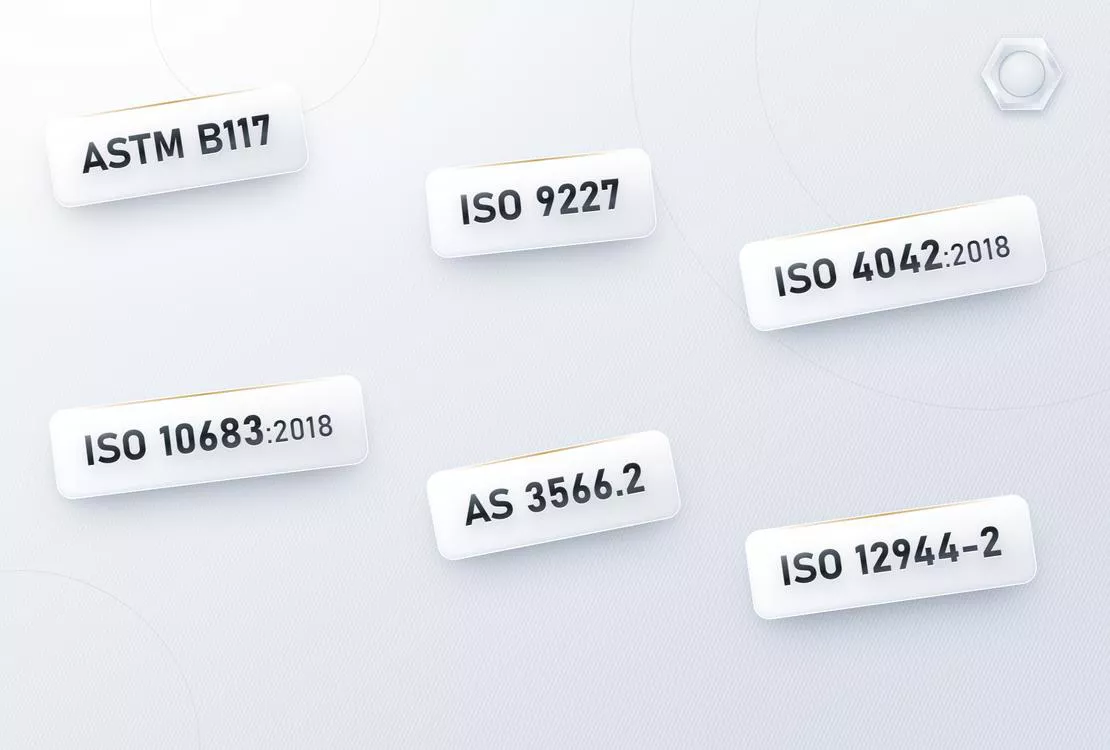
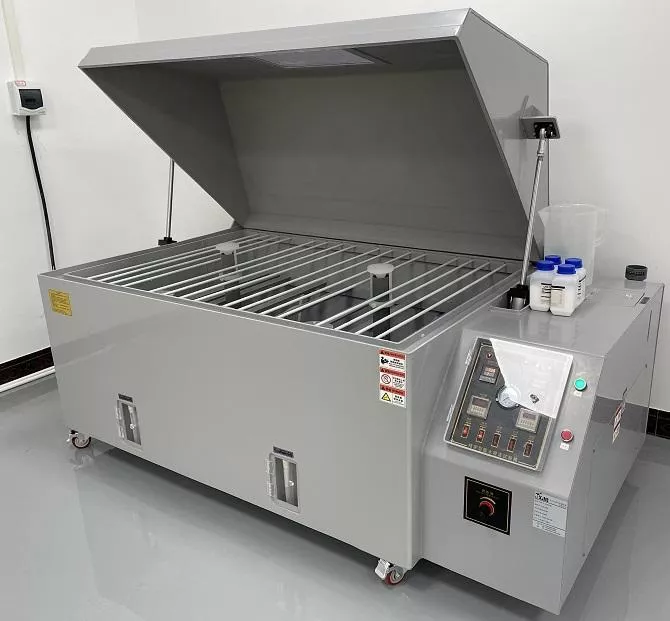
ASTM B117 and ISO 9227 describe how to conduct salt spray tests. Neither standard sets a minimum number of hours that a coating must withstand.
ASTM B117 — Standard Practice for Operating Salt Spray (Fog) Apparatus
ISO 9227 — Corrosion tests in artificial atmospheres — Salt spray tests, including the Neutral Salt Spray (NSS) method
The main NSS test conditions specified in ISO 9227 are:
| Parameter | Requirement |
|---|---|
| NaCl concentration | 50 g/L ± 5 g/L (5%) |
| Chamber temperature | 35 °C ± 2 °C |
| pH of collected solution | 6.5–7.2 |
| Fog deposition rate | 1–2 mL/h per 80 cm² |
| Test duration | Determined by the relevant product standard or customer specification |
The distinction is important: ISO 9227 specifies the test method, not the required test duration. The number of hours must come from another source, such as ISO 4042 for electroplated coatings, ISO 10683 for zinc flake coatings, or an agreed customer specification.
Test results are commonly reported in terms of time to red rust (the first visible corrosion of the base metal) and time to white rust (the first visible white corrosion products on the zinc coating). These are separate measurements and should be specified individually in the purchase order.
Before comparing the coatings that do have defined test requirements, it is worth looking at several common finishes for which published standards do not specify a minimum NSS duration.
| Coating | Governing standard | Does it specify salt spray hours? |
|---|---|---|
| Black oxide | ISO 16048 / MIL-DTL-13924 | No — no NSS duration requirement |
| Zinc phosphate | ISO 9717 | No — coating weight only |
| Mechanical zinc | ASTM B695 / ISO 12683 | No — thickness classes only |
| Hot-dip galvanizing (general steel) | ISO 1461 / ASTM A123 | No — thickness only |
| Hot-dip galvanizing (fasteners) | ISO 10684 / ASTM A153 | No — thickness only |
| Stainless steel | ISO 3506-1 | No — classified by steel grade and mechanical properties, not salt spray hours |
If a supplier quotes "24 hours for black oxide" or "1,000 hours for hot-dip galvanizing," those figures should be treated as results from the supplier's own testing, not as requirements established by an international standard. They may be useful reference points, but results from different suppliers are not necessarily comparable.
For these coating systems, it is generally more appropriate to specify coating thickness or coating mass, where the relevant standard provides such requirements.
For example, ISO 1461 specifies minimum coating thicknesses for hot-dip galvanized articles according to the thickness of the base steel:
| Base steel thickness | Local minimum | Average minimum |
|---|---|---|
| > 6 mm | 70 µm | 85 µm |
| > 3 mm to 6 mm | 55 µm | 70 µm |
| 1.5 mm to 3 mm | 45 µm | 55 µm |
| < 1.5 mm | 35 µm | 45 µm |
| Castings ≤ 6 mm | 60 µm | 70 µm |
Centrifuged parts, including most threaded fasteners, are covered separately by ISO 10684. This standard specifies coating thickness according to thread diameter rather than using the general ISO 1461 table above.
As a result, the thickness requirements for a hot-dip galvanized bolt are not the same as those for a structural steel beam.
ISO 4042 covers electrodeposited coating systems for fasteners, including conventional zinc plating, zinc-iron and zinc-nickel coatings.
Table 8 of ISO 4042:2018 specifies the minimum neutral salt spray durations for different coating systems and thicknesses. The following figures are expressed in hours.
| Coating system (ISO 4042 code) | First white corrosion | Red rust @ 5 µm | Red rust @ 8 µm | Red rust @ 12 µm |
|---|---|---|---|---|
| Zn, clear passivate (Zn//An/T0) | 8 h | 48 h | 72 h | 96 h |
| Zn, iridescent passivate (Zn//Cn/T0) | 72 h | 120 h | 192 h | 240 h |
| Zn, iridescent + seal (Zn//Cn/T2) | 120 h | 168 h | 240 h | 288 h |
| Zn, black + seal (Zn//Fn/T2) | 24 h+ | 72 h | 144 h | 192 h |
| ZnFe, iridescent (ZnFe//Cn/T0) | 96 h | 144 h | 216 h | 264 h |
| ZnFe, iridescent + seal (ZnFe//Cn/T2) | 120 h | 216 h | 288 h | 360 h |
| ZnFe, black + seal (ZnFe//Fn/T2) | 96 h+ | 192 h | 240 h | 312 h |
| ZnNi, silver passivate (ZnNi//Cn/T0) | 120 h | 480 h | 720 h | 720 h++ |
| ZnNi, silver + seal (ZnNi//Cn/T2) | 168 h | 600 h | 720 h | 720 h++ |
| ZnNi, black passivate (ZnNi//Fn/T0) | 43 h+ | 360 h | 600 h | 720 h++ |
| ZnNi, black + seal (ZnNi//Fn/T2) | 120 h+ | 480 h | 720 h | 720 h++ |
* White haze is not classified as white corrosion for these systems.
** Typically higher; the standard stops the test at 720 h.
A few points are worth noting when comparing these results.
1. Passivation chemistry can make a substantial difference. At 12 µm, clear zinc provides 96 hours to red rust, while zinc with iridescent passivation and a seal provides 288 hours. Both have the same nominal coating thickness, but their corrosion resistance differs considerably.
2. Yellow zinc is not a single coating specification. Zn//Cn/T0 and Zn//Cn/T2 are different systems. The addition of a seal changes the test performance, so the colour alone does not tell you what level of protection to expect.
3. Zinc-nickel offers higher corrosion resistance in these test conditions. At 8 µm, the listed zinc-nickel systems reach 720 hours, compared with 72 hours for clear zinc at the same thickness.
When requesting a quotation, simply specifying "zinc plated" does not provide enough technical detail. The coating system, passivation type and thickness should all be stated. For example: Zn//Cn/T2, 8 µm.
ISO 10683:2018 covers non-electrolytically applied zinc flake coating systems for fasteners. This coating family includes products such as Dacromet and Geomet, as well as other zinc flake systems.
Table 1 of the standard gives the following reference categories:
| NSS duration without red rust | Reference coating thickness |
|---|---|
| 240 h | 4 µm |
| 480 h | 5 µm |
| 600 h | 6 µm |
| 720 h | 8 µm |
| 960 h | 10 µm |
The standard makes an important distinction: reference coating thickness is provided for guidance, while corrosion resistance is the decisive acceptance criterion. In other words, the specified salt spray performance matters more than simply achieving a particular thickness.
Ruspert also belongs to the broader zinc flake coating family. However, it is a proprietary Japanese surface-treatment system rather than a specific coating category defined by ISO 10683.
Its salt spray performance is declared by the coating supplier or manufacturer. In our product catalogue, we specify Ruspert 500 h and Ruspert 1000 h as two different performance options. Buyers should confirm which specification is included in a quotation, since the name "Ruspert" alone does not indicate a particular salt spray duration.
For self-drilling screws used in roofing and cladding, AS 3566.2 is an important reference, particularly for products supplied to the Australian market.
The standard classifies corrosion resistance according to the intended service environment rather than simply identifying a coating type.
| Class | Environment | Salt spray requirement (as specified in supplier documentation) |
|---|---|---|
| Class 1 | Indoor, dry | No salt spray requirement |
| Class 2 | Indoor with condensation | No salt spray requirement |
| Class 3 | General exterior, light industrial, mild marine | 1,000 h NSS + 15 SO₂ cycles |
| Class 4 | Coastal, medium to severe marine, heavy industrial | 1,500 h NSS + 25 SO₂ cycles |
Two points need attention when using these figures.
First, AS 3566.2 also includes a Kesternich sulphur dioxide test (ISO 6988). Passing the NSS test alone does not demonstrate full compliance with the corrosion requirements. The specified SO₂ cycles must also be completed.
Second, the commonly quoted 1,000-hour and 1,500-hour figures come from the 2002 edition. AS 3566.2:2025 has since been published, so the applicable requirements should be checked against the current edition before being included in a purchase contract.
Salt spray test results are often used in product comparisons, but they should not be treated as a direct prediction of service life.
Both ISO 10683 and ISO 4042 include warnings about this limitation.
ISO 10683:2018, Clause 5.1 states that corrosion resistance measured through accelerated corrosion tests cannot be directly related to the corrosion protection performance of a product in a particular service environment.
ISO 4042:2018, Table 8, note similarly cautions that the minimum NSS test duration should not be regarded as a direct indication of how coated fasteners will perform in every environment.
Therefore, 1,000 hours in a salt spray chamber does not mean 10 years of outdoor service. These tests are useful for comparing coating performance under controlled conditions, but actual service life depends on the environment in which the fastener is used.
For a more meaningful assessment, the corrosivity of the intended environment needs to be considered.
ISO 12944-2:2017 classifies atmospheric corrosivity according to the measured loss of metal after one year of exposure. It is widely used as a reference in the steel construction industry.
| Category | Corrosivity | Carbon steel loss | Zinc loss | Typical environment |
|---|---|---|---|---|
| C1 | Very low | ≤ 1.3 µm/yr | ≤ 0.1 µm/yr | Heated, clean interiors |
| C2 | Low | > 1.3–25 µm/yr | 0.1–0.7 µm/yr | Rural, unheated interiors |
| C3 | Medium | > 25–50 µm/yr | 0.7–2.1 µm/yr | Urban, light industrial, low-salinity coastal |
| C4 | High | > 50–80 µm/yr | 2.1–4.2 µm/yr | Industrial, moderate-salinity coastal |
| C5 | Very high | > 80–200 µm/yr | 4.2–8.4 µm/yr | Heavy industrial, high-salinity coastal |
| CX | Extreme | > 200–700 µm/yr | 8.4–25 µm/yr | Offshore, tropical marine, splash zones |
For fastener buyers, the zinc-loss figures provide a useful indication of how quickly a sacrificial zinc coating may be consumed in different atmospheric conditions.
However, ISO 12944-2 classifies environments, not individual fasteners or their coatings. Selecting a suitable coating for a particular corrosivity category still requires engineering judgement and agreement between the buyer and supplier.
Choosing a coating for concrete screws and anchors involves more than comparing salt spray hours. The manufacturing process and mechanical properties of the fastener also need to be considered.
For buyers, this means that coating specifications should be considered alongside the actual manufacturing and installation process, rather than relying on a test-panel result alone.
When placing an order for coated fasteners, the following details help avoid misunderstandings between buyers, suppliers and testing laboratories.
1. Specify the standard and test requirement, not just a number. For example, "720 h without red rust according to ISO 10683:2018, Table 1" is much clearer than "high corrosion resistance."
2. Distinguish between white rust and red rust. A coating that develops white corrosion after 120 hours but does not develop red rust until 480 hours has a different performance profile from one that develops white corrosion after just 24 hours.
3. Identify the coating system, not just its colour. Specify details such as Zn//Cn/T2, 8 µm, flZn/720 h, or the applicable AS 3566.2 class.
4. Request the salt spray test report. Check whether the sample was tested in its as-coated condition, after assembly, or after installation. These conditions can produce different results.
5. Do not convert salt spray hours into years of service life. If the fastener will be used in a particular outdoor or coastal environment, assess the environmental corrosivity under ISO 12944-2 before selecting a coating.
How many salt spray hours does a zinc-plated bolt need?
There is no single requirement for all zinc-plated bolts. ISO 4042:2018 specifies different minimum durations depending on the coating system and thickness. For example, clear zinc at 8 µm provides 72 hours to red rust, while iridescent passivation with a seal at the same thickness provides 240 hours. Zinc-nickel at 8 µm can reach 720 hours under the listed test conditions. The coating designation and thickness should be specified when ordering.
Is 1,000 hours of salt spray equal to 10 years outdoors?
No. ISO 10683:2018, Clause 5.1, and the note to ISO 4042:2018, Table 8, both caution against directly relating accelerated test results to performance in actual service environments. Salt spray hours are useful for comparing coatings under controlled conditions, while ISO 12944-2 helps classify atmospheric corrosivity.
What salt spray hours does hot-dip galvanizing have?
There is no universal salt spray duration specified for hot-dip galvanizing in the standards listed here. ISO 1461, ASTM A123, ISO 10684 and ASTM A153 primarily specify coating thickness requirements. Any salt spray hour figure quoted by a supplier should therefore be identified as a test result or manufacturer specification.
Can concrete screws be hot-dip galvanized?
In practice, hot-dip galvanizing is generally unsuitable for hardened self-tapping concrete screws because the coating thickness and processing conditions can interfere with the thread geometry. Zinc flake coatings covered by ISO 10683 are a more suitable option when higher corrosion resistance is required.
What salt spray hours does 304 or 316 stainless steel achieve?
Stainless steel fasteners are not assigned a standard salt spray hour rating under ISO 3506-1. The standard classifies stainless fasteners by steel grade, such as A2 (commonly associated with 304) and A4 (commonly associated with 316), as well as mechanical property class. NSS testing may be used for specific purposes, such as evaluating surface contamination or passivation quality, but it does not establish a universal service-life rating for stainless steel.
ISO 9227 — Corrosion tests in artificial atmospheres — Salt spray tests (NSS method parameters)
ASTM B117 — Standard Practice for Operating Salt Spray (Fog) Apparatus
ISO 4042:2018 — Fasteners — Electrodeposited coating systems, Table 8 and its notes
ISO 10683:2018 — Fasteners — Non-electrolytically applied zinc flake coating systems, Table 1, Clauses 5.1 and 5.4
ISO 1461 — Hot dip galvanized coatings on fabricated iron and steel articles, Table 3
ISO 10684 — Fasteners — Hot dip galvanized coatings
ASTM A153 / ASTM B695 — Hot-dip galvanizing of hardware; mechanically deposited zinc coatings
AS 3566.2 — Self-drilling screws for the building and construction industries, Part 2: Corrosion resistance requirements (2002 edition values as quoted; 2025 edition now published)
ISO 12944-2:2017 — Corrosive classification of atmospheres
ISO 3506-1 — Mechanical properties of corrosion-resistant stainless steel fasteners
RHINO / MEIGESI product catalogue — Ruspert 500 h / 1000 h and Dacromet 500 h coating tiers (manufacturer specifications, not standard requirements)