Hello everyone. The 2026 Fastener Expo has successfully concluded. As someone relatively new to the fastener industry, I gained valuable insights into fastener applications and selection during the exhibition. Here I would like to summarize several practical takeaways that may be helpful for industry peers and newcomers.
1. How Material Selection Affects Flat Washers
In practical applications, a flat washer is not just a simple load-distribution component. Its material properties directly affect processing performance, temperature resistance, and overall service reliability.
Recently, we encountered a case where a batch of flat washers underwent post-treatment such as painting or powder coating after delivery. However, due to improper temperature control during secondary processing, performance issues occurred after coating. To address this problem, we consulted technical specialists and focused on the temperature resistance of rubber materials used in related applications.
Common Elastomer Materials
1. FKM (Fluorocarbon Rubber)
-
Typical temperature range: -20°C to 180°C
-
Key characteristics:
-
Excellent oil and chemical resistance
-
Stable overall mechanical performance
-
High reliability in long-term applications
-
Typical applications:
-
Automotive industry
-
Industrial machinery
-
Mechanical sealing systems
2. VMQ (Silicone Rubber)
-
Temperature range: -50°C to 200°C (or higher depending on formulation)
-
Key characteristics:
-
Excellent high-temperature resistance
-
Strong thermal aging resistance
-
Relatively higher cost compared to FKM
-
Typical applications:
-
High-temperature environments
-
Electrical and electronic equipment
-
Special industrial conditions
Engineering Insight
From an engineering perspective, if a product involves secondary processes such as:
-
Powder coating
-
Baking / curing
-
High-temperature post-treatment
then material selection must be defined at the design stage rather than being based solely on normal service conditions. Otherwise, performance degradation or material failure may occur during post-processing.
Improvement Options Discussed
To solve the issue mentioned above, two optimization approaches were considered:
-
Improving the FKM formulation to increase the temperature resistance close to 200°C
-
Or switching to a VMQ silicone rubber solution for high-temperature applications
2. How to Distinguish Drywall Screws, Chipboard Screws, and Timber Screws
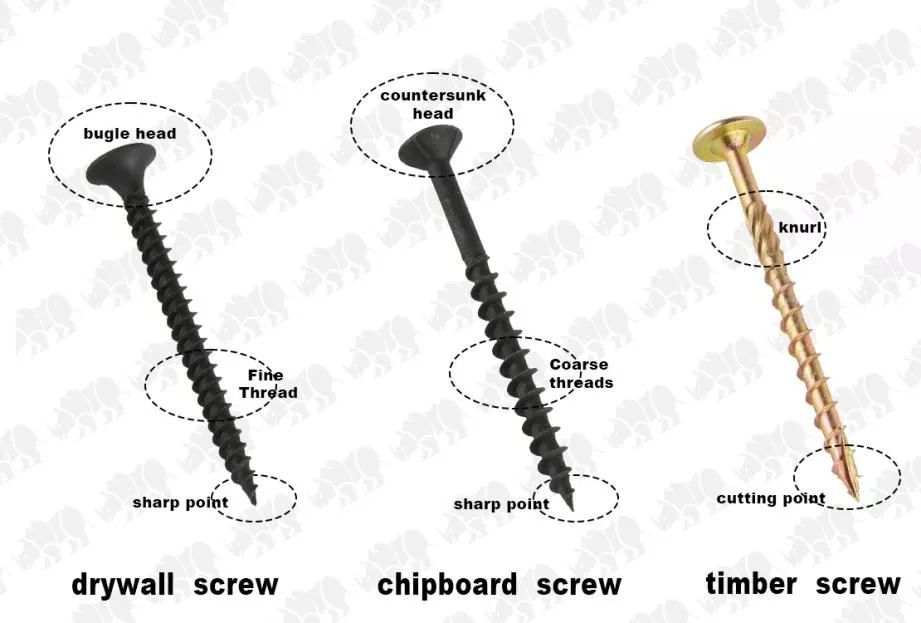
Although these screws may look similar externally, they differ significantly in head design, thread geometry, and application fields.
1. Drywall Screw
Drywall screws are primarily used for gypsum board installation.
-
Bugle head design
-
The curved "trumpet-like" head helps distribute stress
-
Reduces damage to the gypsum board surface
-
Thread type: Fine thread or partially double-threaded design
-
Surface finish: Commonly black phosphate or black oxide coating
-
Typical applications:
-
Gypsum board fixing
-
Light steel framing systems
2. Chipboard Screw
Chipboard screws are mainly designed for wood-based and engineered boards.
-
Countersunk head design
-
Allows full flush embedding into the surface
-
Self-tapping sharp point
-
Facilitates fast penetration into board materials
-
Thread design: Coarse threads for higher holding power
-
Typical applications:
-
Chipboard (particle board)
-
Medium-density fiberboard (MDF)
-
Furniture assembly
3. Timber Screw (Wood Construction Screw)
What is sometimes referred to as a "grass rope screw" is more commonly known in the industry as a timber screw or wood construction screw.
-
Head type: Countersunk head or large round head (depending on design)
-
Tip design:
-
Cutting point or drill point tip
-
Some versions include anti-splitting serrations
-
Thread design: Deep and coarse threads for high load-bearing performance
-
Typical applications:
-
Solid wood structures
-
Outdoor timber construction
-
Heavy-duty wood connections
Basic Knowledge of Gas Pins
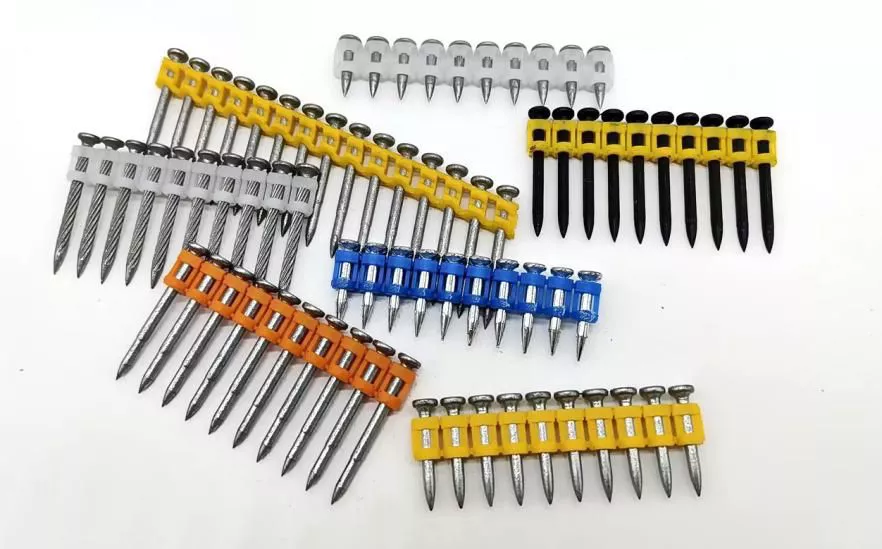
Gas pins are widely used in construction for fastening into concrete and steel substrates, offering high installation efficiency.
1. Function of Plastic Components
The plastic parts on gas pins (such as plastic strips or color-coded carriers) are mainly used for:
-
Differentiating sizes and strength grades
-
Enabling automatic feeding in fastening tools
-
Improving installation efficiency
Important note: The plastic component does not contribute to the structural load-bearing capacity and does not affect the final fastening strength.
2. Common Manufacturing Processes
Gas pins are generally produced using two main manufacturing methods:
(1) Traditional Cold Heading Process
-
Process flow typically includes:
-
Cold heading forming
-
Tail shaping (cutting or trimming)
-
Thread rolling
-
Key characteristics:
-
Mature and stable technology
-
High dimensional consistency
-
Suitable for mass industrial production
-
Widely used for standard fasteners
(2) Integrated Forming Process
-
Key characteristics:
-
One-step forming process with fewer operations
-
Higher production efficiency
-
Lower manufacturing cost
-
Slightly lower strength consistency compared to traditional cold heading in some applications











.png)
