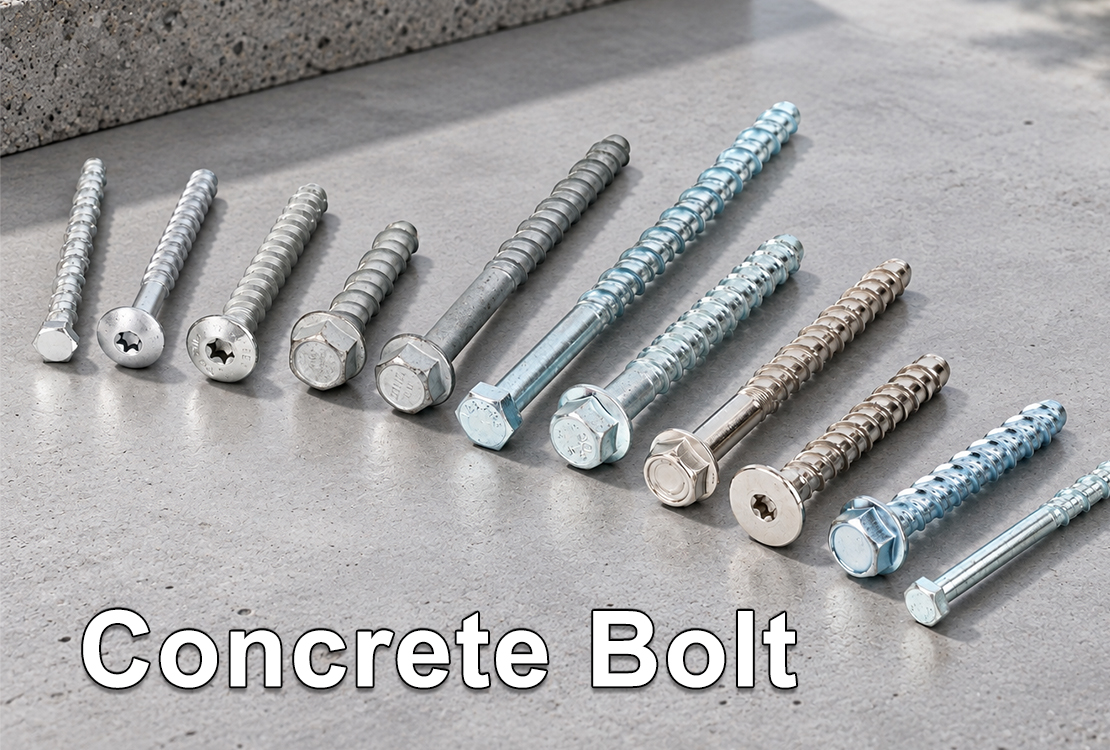



Ask ten buyers for a "concrete bolt" and you will get two different products back. Some mean an expansion anchor that grips the hole by force. The others — and increasingly the majority on busy construction sites — mean a self-tapping concrete screw: a hardened fastener that cuts its own thread into a pre-drilled hole in concrete, brick or block, with no anchor body and no expansion force.
This second type is the one that has quietly taken over the category. It installs in seconds, it comes back out when the layout changes, and it works closer to the edge of a slab than any expansion anchor can. That is why it shows up everywhere in fit-out, MEP, racking, guardrails, facade work and temporary fixing — and why buyers re-order it in cartons, not once a year.
Here is how a concrete bolt works, how to size it, and what to check before you order.
The terminology, settled in one paragraph
A concrete bolt, a concrete screw and a concrete screw anchor are the same product family. The fastener taps directly into a pre-drilled hole in the base material — there is no expansion clip, no sleeve and no resin.
The confusion comes from a brand name. Tapcon is the original and best-known concrete screw; "concrete screw" and "cement screw" are the generic terms, and "concrete bolt" is what the trade tends to call the hex-headed versions. If an enquiry says Tapcon, concrete screw or concrete bolt, a competent supplier should be quoting the same thing.
How it holds — and why "expansion-free" matters
A concrete screw has a hardened thread with a reduced core and a pronounced crest. The pilot hole is drilled to a diameter matched to the fastener, and as the screw is driven, the crest cuts mating grooves into the wall of the hole. Holding power comes from that mechanical interlock.
Because nothing pushes outward against the concrete:
- It can be installed close to an edge, where an expansion anchor would split the concrete
- Spacing between fixings can be tighter
- Thin sections are not at risk of bursting
- The fixing is removable — back it out and the fixture comes with it
That last point has a condition worth stating honestly: the screw cuts the concrete on installation, so a screw reinstalled into the same hole will not develop full capacity. For non-structural repositioning this rarely matters. For a structural connection, treat the hole as spent and drill a new one.
Sizes and the two numbers that matter
Our metric concrete bolts run from a 5 mm pilot hole up to 16 mm, with thread diameters from M6 to M18 and lengths from 40 mm to 260 mm. Here is the standard specification for our core metric range:
| Pilot hole dia. | Thread OD | Length (mm) | Pcs / box | Min. hole depth | Wrench size | Coating thickness |
|---|---|---|---|---|---|---|
| M5 | M6 | 40–120 | 100 / 200 / 500 | L + 10 mm | SW8 | ≥ 5 µm |
| M6 | M8 | 40–260 | 25 / 50 / 100 | L + 10 mm | SW10 | ≥ 5 µm |
| M8 | M10 | 40–260 | 25 / 50 / 100 | L + 10 mm | SW13 | ≥ 5 µm |
| M10 | M12 | 60–260 | 15 / 25 / 50 | L + 10 mm | SW17 | ≥ 5 µm |
| M12 | M14 | 60–260 | 15 / 25 / 50 | L + 10 mm | SW19 | ≥ 5 µm |
| M14 | M16 | 80–260 | 10 / 15 / 25 | L + 10 mm | SW22 | ≥ 5 µm |
| M16 | M18 | 80–260 | 10 / 15 / 25 | L + 10 mm | SW24 | ≥ 5 µm |
Minimum embedment into the base material: 60 mm.
Two rules get misread more often than any other:
- Hole depth = bolt length + 10 mm. The extra 10 mm is not optional padding — it is clearance for drilling dust. Drill shallow and the screw bottoms out on debris instead of reaching depth.
- Thread length is capped at 100 mm in this range. Longer bolts have an unthreaded shank, which is intentional: it lets the fixing span a fixture thickness without the thread engaging the fixture itself.
For inch-series work we also supply 1/4", 5/16", 3/8", 1/2" and 5/8" up to 10" overall.
Head and thread variants — and what each one is for
This is where a concrete bolt order usually goes wrong. The variants are functional, not cosmetic:
| Variant | What it does |
|---|---|
| Hex flange head | Standard load-carrying drive; the flange spreads clamp load over the fixture |
| Serrated hex flange | Teeth under the flange bite into the fixture and resist loosening under vibration |
| With 4 cuttings | Four cutting channels clear debris as the screw drives — faster installation, less torque, more consistent engagement in hard concrete |
| Ruspert coating | Multi-layer corrosion protection for exterior and coastal exposure |
| Nylok coating / painting | Added locking and colour coding; often specified where fixings are visible |
| Countersunk / Torx drive | Flush finish where the head must not stand proud |
| Mushroom head | Wide bearing surface for thin or soft fixtures |
| Eye head | The fixing doubles as an anchor point for hanging or tying |
| Ceiling / threaded rod hangers | Purpose-built for overhead services — anchor and suspension point in one part |
Cracked concrete: the question most suppliers cannot answer
Here is what most buyers are not told. Modern concrete design codes — EN 1992-4 clauses 4.5 and 4.7 in Europe, and ACI 318 clause 17.10.5.4 in the US — require designers to assume cracked concrete unless the member can be shown to stay uncracked for its whole working life. Seismic design is cracked-concrete design by definition (EN 1992-4 clause 9.2.2, ACI 318 R17.10.5.4), and fire exposure also requires an assessment covering cracked concrete (EN 1992-4 clause D.1).
Most general-purpose concrete screws on the market are evaluated for uncracked concrete only. If your project specification assumes cracked concrete — which, under current codes, it probably does — a standard concrete screw is not a compliant answer.
Our concrete bolts are tested and rated for cracked concrete as well as non-cracked and solid concrete, across the C20/25 to C50/60 strength range, and are supplied with ETA documentation. If a project asks you for cracked-concrete performance, ask the supplier for the assessment by name — not just the word "approved."
Installation: five steps that decide the result
1.Drill with a carbide-tipped masonry bit in hammer mode. Standard HSS bits will not survive concrete.
2.Drill to bolt length + 10 mm.
3.Clean the hole. Blow or vacuum the dust out. Dust at the bottom of the hole is the most common reason a screw stops short of depth.
4.Switch off hammer mode and drive the screw. Hammering while the thread is cutting vibrates the interlock loose.
5.Do not over-drive. Once the head is seated, stop. Over-driving strips the grooves the thread has just cut.
On pilot hole sizing for inch-series work, the working rule is one bit size below the screw's outside thread diameter — 5/32" for a 3/16" screw, 3/16" for a 1/4" screw, 5/16" for a 3/8" screw.
Base materials
| Substrate | Suitability |
|---|---|
| Concrete C20/25 – C50/60 | Primary application |
| Natural hard stone | Yes |
| Solid brick | Yes |
| Hollow brick / block | Yes, with the correct variant and engagement depth |
| Steel structures | Yes, for fixing to steel sections |
| Wood | Yes, for timber-to-concrete fixings |
Coating and material
Concrete is alkaline and frequently damp, so the finish decides service life.
| Environment | Recommended finish |
|---|---|
| Dry interior | Zinc plated (Zn3+) |
| Exterior, general | Ruspert, or mechanical zinc plated |
| Coastal / chloride / chemical | Ruspert at higher build, or stainless steel |
| Visible architectural fixings | Painted or Nylok coated |
Available in carbon steel and stainless steel, with Zn3+, Ruspert and mechanical zinc plating as standard finishes, plus painted and Nylok-coated variants. Minimum coating thickness on the standard metric range is ≥ 5 µm.
Where concrete bolts are used
Guardrails and balustrades, metal profiles and brackets, facade sub-frames, cable tray and pipework supports, temporary anchoring and formwork, racking, and ceiling suspension — including a dedicated range of ceiling and threaded-rod hangers for overhead services.
FAQ
What is a concrete bolt? A concrete bolt is a self-tapping concrete screw: a hardened fastener that cuts its own thread into a pre-drilled hole in concrete, brick or block, without an expansion anchor. Some buyers use the term for expansion anchors, so it is worth confirming which is meant.
Is Tapcon the same as a concrete screw? Tapcon is a brand name for the original concrete screw. "Concrete screw," "cement screw" and "concrete bolt" are generic names for the same product family.
How deep should the hole be? Minimum hole depth is the bolt length plus 10 mm — the extra 10 mm is clearance for drilling dust. Minimum embedment into the base material is 60 mm.
Can concrete bolts be used in cracked concrete? Only if the product is assessed for it. Ours are tested and rated for cracked, non-cracked and solid concrete across C20/25 to C50/60, with ETA documentation. Most general-purpose concrete screws are rated for uncracked concrete only.
Can concrete bolts be removed? Yes — that is one of the main advantages over expansion anchors. They are listed as reusable, though a screw reinstalled into the same hole will not develop full capacity. For structural connections, drill a new hole.
What sizes are available? Metric pilot hole diameters M5 to M16 with thread diameters M6 to M18, lengths 40–260 mm and thread length up to 100 mm. An inch series is also available in 1/4", 5/16", 3/8", 1/2" and 5/8" up to 10".
What is the difference between a hex flange head and a serrated flange head? The serrated flange has teeth under the head that bite into the fixture and resist loosening under vibration. The plain flange distributes clamp load without marking the fixture.
Do concrete bolts hold close to an edge? Yes — better than any expansion anchor, because there is no expansion force pushing the concrete apart. Edge distance is still a design parameter, so confirm against the load table.
Concrete bolts from RHINO
YUYAO RHINO HARDWARE CO., LTD. has manufactured anchors since 2015 to European quality standards and supplies European partners on a long-term basis. Our concrete bolt range includes:
- Metric Hexagonal Flange Head Concrete Bolt F004 — M5–M16, 40–260 mm, ETA, rated for cracked and non-cracked concrete
- Ruspert Coating Hex Flange Head Concrete Bolt F001 — for exterior and coastal exposure
- High Load Hex With Flange Concrete Screw Anchor F006 — for higher load requirements
- Plus serrated flange, 4-cuttings, countersunk Torx, mushroom head, eye head, and a full ceiling / threaded rod hanger programme
See the full Concrete Bolt range →
Send us your size, base material and load requirement and we will confirm the right specification and quote.
- Documentation: ETA, load tables, test reports, inspection records
- Packing: small boxes, cartons or pallets — box quantities tailored to your channel
- Samples available for approval before you commit