


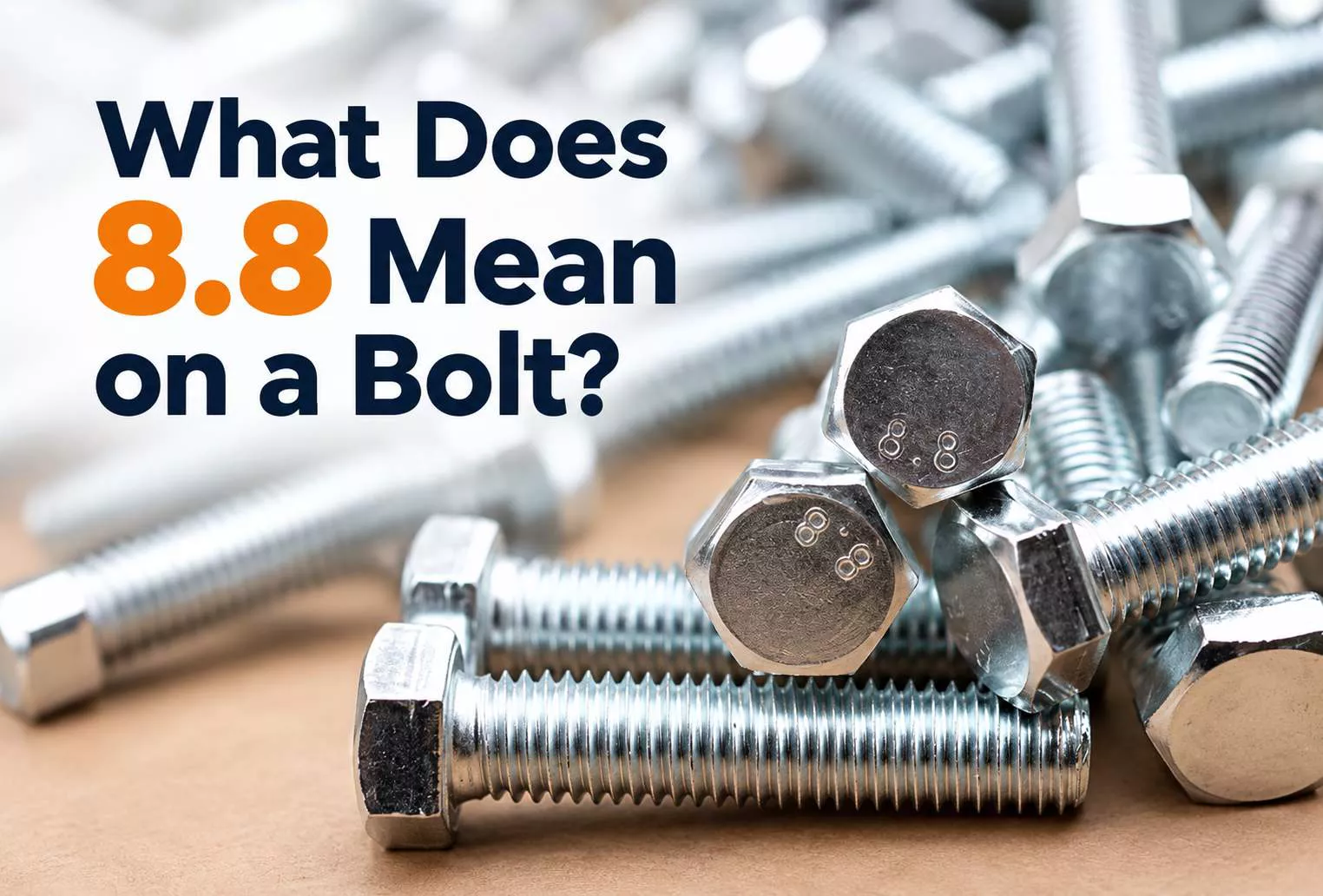
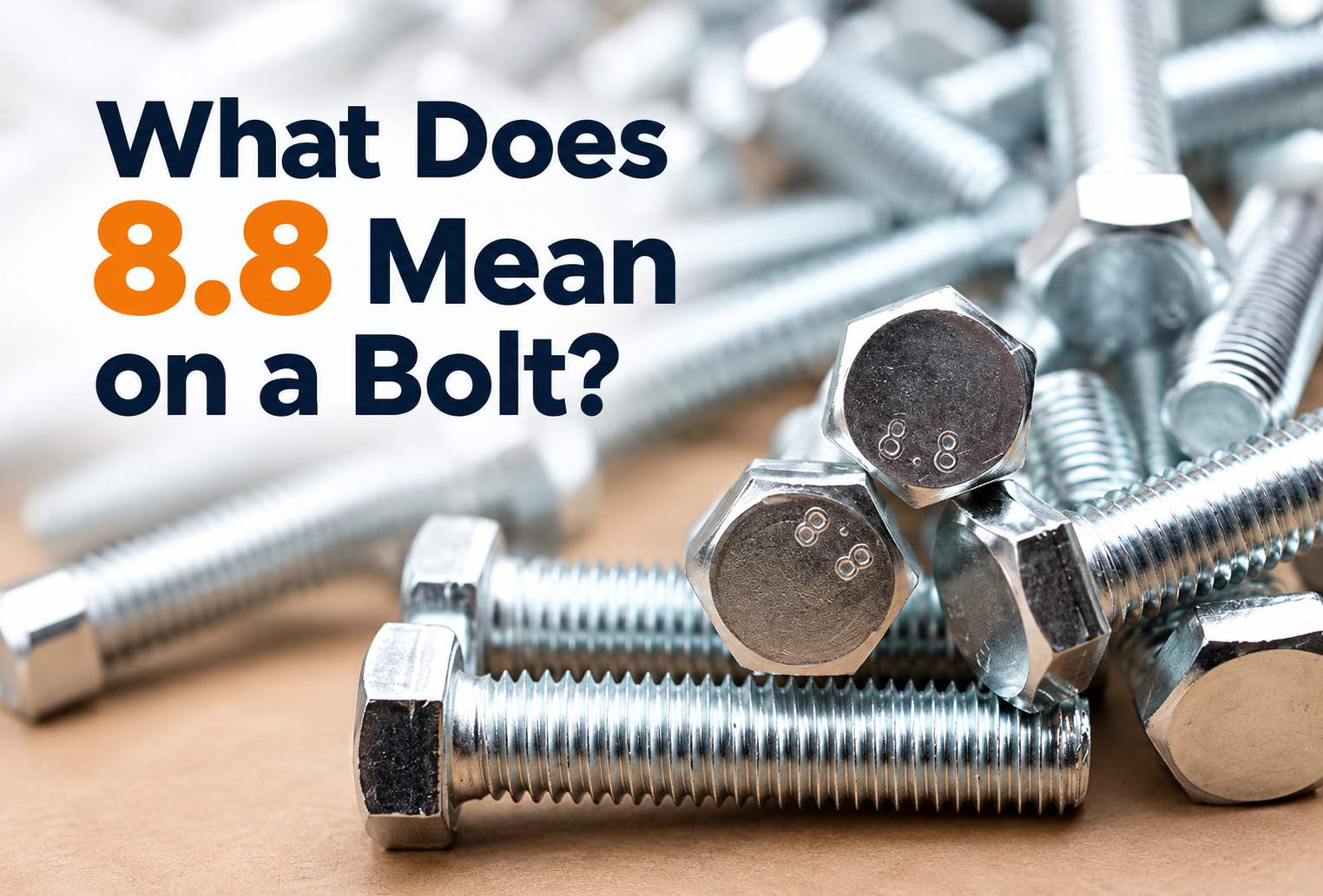
When buying metric bolts, you may often see markings such as 4.6, 5.8, 8.8, 10.9, or 12.9 in product specifications. Among these, 8.8 is one of the most commonly used property classes for metric bolts and screws. It is widely found in machinery, construction equipment, automotive applications, steel structures, industrial equipment, and general engineering.
But what does 8.8 actually mean?
The answer is more specific than simply saying that an 8.8 bolt is a “strong bolt.” The number 8.8 is a mechanical property class designation defined under standards such as ISO 898-1. It describes the mechanical performance level of the fastener, particularly its tensile strength and resistance to permanent deformation. It does not tell you the bolt's diameter, coating, thread size, or exact steel grade.
Understanding this distinction is important because an 8.8 designation is only one part of a complete bolt specification. A buyer selecting fasteners for an engineering application still needs to consider the bolt dimensions, thread, standard, surface treatment, nut compatibility, operating environment, and required documentation.
The “8.8” in an 8.8-grade bolt refers to its strength grade, not its size.
The first “8” before the decimal point means the bolt has a tensile strength of 800 MPa. In simple terms, before it breaks, every square millimeter of the bolt can withstand up to 800 newtons of force.
The second “8” means the yield strength is 80% of the tensile strength, which is 640 MPa. In other words, once the force exceeds this level, the bolt starts to deform permanently. After the load is released, it won’t spring back to its original shape on its own.
8.8 grade has nothing to do with an 8.8 mm diameter. 8.8 is the strength grade, while the diameter is the product size.
In M8, M10, and M12, the numbers 8, 10, and 12 refer to the diameter. For example, M8 means the bolt has a nominal diameter of 8 mm.
Therefore, when purchasing nuts, you should provide both the size and the strength grade to get accurate product information.
Not exactly.
An important distinction in fastener purchasing is the difference between material grade and property class. The designation 8.8 is a property class, not a unique steel grade or chemical composition.
Different manufacturers may use suitable carbon steel or alloy steel materials and appropriate heat-treatment processes to produce fasteners that meet the required mechanical properties. The important point is that the finished fastener must comply with the applicable mechanical and physical requirements.
The manufacturing of 8.8-grade bolts follows a simple principle: form first, strengthen later.
The raw material is usually medium-carbon or low-alloy steel, such as 35K, ML35, or 40Cr. After pretreatment such as pickling, phosphating, and wire drawing, the bolt head is formed by cold heading, followed by thread rolling. At this stage, the material needs to have good plasticity so it can be formed without cutting.
After forming, the bolts go through heat treatment. They are first heated to around 850°C for austenitizing and then quenched to obtain a martensitic structure. They are then tempered at around 500–680°C to obtain tempered sorbite. This process balances strength and toughness, giving the bolts a tensile strength of 800 MPa and a yield strength of 640 MPa.
Finally, surface treatments such as black oxide or zinc plating can be applied according to the application requirements.
The key challenge in the whole process is the conflict between low hardness, which is needed for cold heading, and high strength, which is required for the finished bolt. This is solved through the final heat-treatment process.
Tensile strength is probably the property most buyers associate with 8.8 bolts, but it is not the only requirement.
ISO 898-1 specifies a range of mechanical and physical requirements for fasteners within its scope. Depending on the fastener type and applicable requirement, these can include tensile strength, proof or yield-related properties, elongation, reduction of area, hardness, surface hardness, decarburization, carburization-related surface condition, proof load, and other characteristics.
This matters because a bolt can have an acceptable hardness reading while still failing to meet another important mechanical requirement. A reliable quality-control process therefore uses more than one inspection method when the application and inspection plan require it.
For buyers purchasing large quantities of 8.8 bolts, it is often useful to clarify in advance which test reports or inspection documents will be supplied with the shipment. Depending on the order and agreed quality requirements, documentation may include dimensional inspection, mechanical test results, material information, coating inspection, and batch traceability.
Property classes such as 8.8, 10.9, and 12.9 represent different mechanical performance levels. As the property class increases, the nominal tensile and proof/yield-related values increase accordingly.
| Property Class | Nominal Tensile Strength | Nominal 0.2% Non-Proportional Elongation Stress |
|---|---|---|
| 4.6 | 400 MPa | - |
| 5.8 | 500 MPa | - |
| 8.8 | 800 MPa | 640 MPa |
| 10.9 | 1000 MPa | 900 MPa |
| 12.9 | 1200 MPa | 1080 MPa |
These figures are useful for understanding the property-class system, but they should not be used as a substitute for the complete requirements of the applicable standard.
A higher property class is not automatically the correct choice for every application. Engineers normally consider the load, joint design, bolt diameter, tightening method, fatigue requirements, operating environment, corrosion conditions, and other factors before selecting the appropriate fastener.
These two should not be treated as the same thing.
Strength grade and corrosion resistance are two separate systems. The former describes mechanical performance, while the latter describes how well the fastener withstands its environment.
Strength grades such as 8.8, 10.9, and 12.9 specify the bolt’s nominal tensile strength and yield strength. Their values depend on the material composition and heat-treatment process, but they do not indicate improved corrosion resistance.
Corrosion resistance mainly depends on the base material and surface treatment, such as stainless steel, zinc plating, or Dacromet coating.
When purchasing fasteners, consider your actual application requirements and find the right balance between mechanical strength and corrosion resistance.
Absolutely. 8.8-grade bolts can be zinc plated.
However, it is important to note that high-strength bolts are more sensitive to hydrogen embrittlement and stress corrosion. In corrosive environments, improper surface treatment can actually increase the risk of failure compared with medium- and low-strength bolts.
That is why extra care is needed when zinc plating 8.8-grade bolts. Even if the bolts look perfectly normal after zinc plating, the potential risk should not be overlooked.
In theory, an “8.8-grade bolt should be paired with a grade 8 nut”. The core principle when matching bolts and nuts is simple: “the nut’s proof load should be higher than the bolt’s load capacity”.
This way, if the fastener is over-tightened or overloaded, the bolt is more likely to fail before the nut threads strip. Thread stripping is a gradual deformation that can be difficult to notice, making it a greater hidden risk. Bolt fracture, on the other hand, is sudden and easier to detect.
Also, if you need to use a thin nut, keep in mind that “thin nuts (Type 0) have a lower load-bearing capacity than standard nuts”. They should not be used on their own as a replacement for a standard grade 8 nut.
Not exactly. The scope of the standard matters.
According to "GB/T 3098.1", 8.8-grade bolts are specifically covered when they are made of carbon steel or alloy steel, comply with the requirements for metric coarse-pitch threads, and fall within the size range of M1.6 to M39. Products outside this scope, such as set screws that are not designed to carry tensile loads, are not covered by this standard.
From a product perspective, 8.8 is widely used as an entry-level strength grade for high-strength bolts. Common products such as hexagon head bolts, socket head cap screws, and studs are available in 8.8 grade. However, some special or non-standard bolts, such as plow bolts and mill liner bolts, are also available in 8.8 grade, but their special head geometry may result in insufficient shear area, making it difficult to meet the tensile or torque requirements specified by the standard.
In terms of applications, 8.8-grade bolts are mainly used where higher strength, greater loads, or higher preload are required, such as steel structures, machinery, and critical automotive applications. For applications involving only light loads and ordinary fastening, a 4.8-grade bolt may be sufficient. Using an 8.8-grade bolt in such cases may simply add unnecessary cost. In addition, high-strength bolts are more sensitive to hydrogen embrittlement and stress corrosion, so they can present additional risks in certain environments.
So, 8.8 is a widely used strength grade, but it has a defined scope of application and cannot be applied to every type of bolt.
When requesting a quotation for 8.8 bolts, the more complete the specification, the easier it is for the supplier to quote the correct product.
At minimum, the purchasing specification should normally include the product type, nominal diameter, length, thread pitch where relevant, applicable product standard, property class, surface treatment, quantity, and packaging requirements.
For example, instead of writing simply:
“8.8 bolts, 100,000 pcs”
a more useful specification might be:
“M16x100 Hexagon Head Bolts, ISO 4014, Property Class 8.8, Zinc Plated, 100,000 pcs.”
If the application is more demanding, additional information may be required, such as thread tolerance, coating requirements, inspection standards, test reports, material requirements, marking, batch traceability, or special packaging.
The goal is to make sure the supplier understands exactly what mechanical, dimensional, and surface requirements the finished fastener must meet.
8.8 is generally considered a higher-strength property class within the commonly used metric carbon/alloy steel fastener system. However, whether it is appropriate for a particular application depends on the actual load and joint requirements.
The property-class calculation gives a nominal tensile strength of 800 MPa. The applicable minimum tensile requirement depends on the nominal diameter and the requirements of ISO 898-1.
No. Property class 10.9 represents a higher nominal mechanical strength level than 8.8. However, the higher class is not automatically the correct choice for every application.
They can be used outdoors when the selected bolt and surface-treatment system provide adequate protection for the actual environmental conditions. The 8.8 designation itself does not indicate corrosion resistance.
The answer depends on the specific materials, standards, loads, environment, and joint design. Material compatibility, mechanical properties, galling risk, corrosion conditions, and tightening requirements should all be considered rather than relying only on the bolt's 8.8 designation.
It identifies the bolt's mechanical property class under the applicable fastener standard. It does not indicate the bolt's diameter or coating.
In simple terms, 8.8 tells you how strong a bolt is, not how big it is or how well it resists corrosion. It is a mechanical property class, and choosing the right 8.8 bolt requires more than looking at the number.
When purchasing, always check the size, thread, product standard, property class, material, surface treatment, and application requirements. Also make sure the bolt and nut are properly matched.
Looking for reliable 8.8-grade bolts? Welcome to Yuyao Meigesi Fastener.
Popular models including DIN 933, DIN 931, DIN 603, DIN 608, and DIN 912 are available. Contact us for product details, specifications, and quotations.









.png)
